
Read Morgan County Property Tax Records
Reading these records starts with knowing which office produced them. The Morgan County Revenue Commissioner handles appraisal, assessment, and mapping. It also runs ad valorem collection under one roof. County routes built on that work will carry parcel facts, value fields, and exemptions. They also show collection status. Each field still carries its own meaning and tax year.
| Field | What It Shows | Where |
|---|---|---|
| Total or appraised value | County fair-market-value estimate at assessment time | CAMA and GIS |
| Assessed value | Class-based portion used in the tax calculation | Assessment record |
| Assessment class | Statutory class applied to the property | Parcel record and calculator |
| Exemption | Relief applied if the parcel and claimant qualify | Revenue record |
| Tax bill and status | Amount due, paid, or delinquent | Tax-payment route |
A recorded sale price and an appraisal are not the same thing. Morgan Revenue defines fair market value as the price willing parties would reach in an arm's-length sale, with no pressure on either side. The office warns that an appraised value will not always match what a property actually sold for.
Morgan County Property Tax Dates and Payment Routes
Morgan Revenue sets October 1 as the due date, with property tax delinquent after December 31. The enforcement schedule then moves through citation fees, sale advertising, and a May tax sale. Not every intermediate date is published, so confirm deadlines on the current county page before relying on them. The How to Pay page lays out the choices. Pay at the courthouse by cash, check, card, or money order. Mail a check or money order to PO Box 696, Decatur, AL 35602, or pay online with major cards. Card payments carry a facilitator convenience fee. Satellite offices in Hartselle and Somerville also take payments. The county-linked online payment entry opens the card-payment route.
The online payment entry requires a live session to return a bill result. Use the portal directly, and save the confirmation it provides.
Morgan County Classes, Districts, and Tax Estimates
The county tax calculator asks for appraised value, class, tax district, and an exemption choice. It then reports assessed value, tax before exemption, the exemption amount, and an estimate. Class II assesses at 20 percent and Class III at 10 percent. District rates differ across the county. So a mailing city cannot stand in for the parcel's actual tax district.
| Decatur District 6 | 45.3 mills |
|---|---|
| Hartselle District 9 | 39.4 mills |
| Falkville District 7 | 42.4 mills |
| Trinity District 10 | 42.4 mills |
| Huntsville District 14 | 46.8 mills |
| County and other districts | 37.4 mills |
Priceville does not appear as its own option in the calculator. Confirm the parcel's district instead of substituting a nearby rate. Treat the calculated figure as an estimate only; the posted account controls what is owed.
Look Up a Morgan County Tax Bill
Start with the Revenue property-search page when only an address is known. It links both Real Property and GIS. Establish the parcel key first, then open the tax-payment entry and compare the bill against the assessment record.
- Search Real Property by street, owner, or parcel components and verify the physical address.
- Copy the PID or PIN, district, class, current value, and assessed value.
- Open the online payment route and use the property key accepted by the live portal.
- Read the tax year, amount, payment status, exemption, and any delinquent balance.
- Assessed value
- The class-based taxable value used before millage and exemptions finish the bill.
- Mill
- A rate unit used in tax calculation.
- Homestead exemption
- Relief that depends on qualification and proper application.
- Tax lien
- A claim arising from unpaid tax, not ownership of the land.
The Four-Year Morgan County Reappraisal Cycle
Revenue reviews 25 percent of Morgan County each year. That covers every parcel across a four-year cycle. A new building can be assessed for the upcoming year. Improvements, pools, demolished structures, exemptions, and millage changes can all move a tax bill. No deed transfer is needed. The portal can also lag the live office, which is a separate issue from reappraisal. Roll entries carry CurrentYear, RecordYear, and PriorYear labels that can point ahead. Quote those labels rather than treating a future-dated roll as settled history. The Revenue answers page gives the county's own explanations of delinquency, appraisal, tax calculation, and protest procedures.
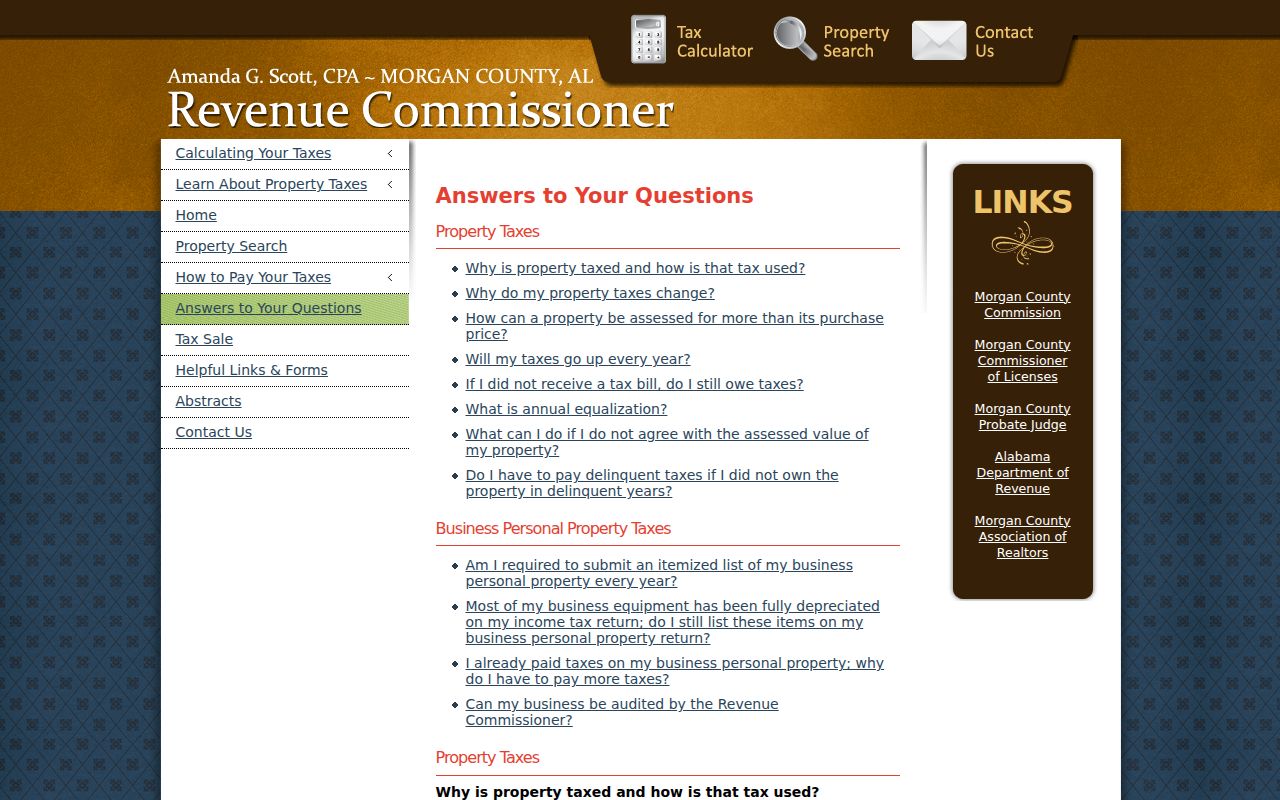
That answers page is the best current county check when a procedure changes. For any single parcel, though, the dated notice still controls its protest timing.
Verify Exemptions on Morgan County Property Tax Records
An exemption changes the taxable result only when the parcel and the claimant both qualify. The Revenue record must also carry the approved relief. Compare the exemption field against current ownership, assessment class, tax district, and the notice itself. A former owner's exemption can distort the picture. So can a missing application or a changed use. Any of these can make an estimate differ from the posted bill. Use the Revenue Commissioner's published answers and contact route for current eligibility. The same route covers forms, proof, and filing timing. The office handles both assessment and collection. A payment receipt proves nothing about exemption eligibility, though. Always include the parcel Key Number or Parcel Number with an inquiry. If the deed is recent, keep the recording citation and closing date too. Online data may lag the live office. Never infer an exemption from an owner name, age, mailing address, or how a property looks. Record only what the official account shows and what Revenue confirms. That keeps a public tax observation separate from a personal eligibility claim.
Build a Morgan County Tax Evidence Packet
A solid Morgan County property tax file combines the parcel card, a dated bill or payment-status screen, the relevant assessment notice, the exemption record, and any appeal correspondence. Label every item with its tax year. The property-search page warns that uploaded data may lag the office. The live GIS also keeps separate current, prior, total, assessed, and sale fields. Mixing those labels can easily create a false year-to-year comparison.
- Save the physical address, owner field, PID or PIN, and legal-description lead from the parcel card.
- Save the bill year, posted amount, status, payment date if shown, and retrieval date from the payment route.
- Record assessment class, tax district, appraised value, assessed value, and exemption as distinct fields.
- Keep the value notice and its mailing or receipt date when a protest may be filed.
- For delinquency, use the current tax-sale list and status rather than an earlier annual notice.
A tidy evidence packet lets Revenue staff reproduce the question quickly. It also keeps a tax-bill dispute separate from a deed or boundary dispute. If the account changes after you save a copy, keep both versions side by side. Never overwrite older evidence without dating it first.
Mail a payment? Keep a copy of the remittance. Add enough account detail to match it to the intended parcel. For counter or online payments, hold on to the receipt. Keep the confirmation the county route supplies too. An assessment screenshot is not a receipt. A pending card screen proves nothing. If a purchaser is researching a transfer, Morgan Revenue warns that buying tax-delinquent property makes the purchaser liable for the outstanding taxes. So verify current status close to the transaction date.
Direct questions to the Revenue Commissioner at 256-351-4690. Those channels settle conflicts fast. The office lists the courthouse at 302 Lee Street NE, Decatur. It gives its mailing address as PO Box 696, Decatur, AL 35602. When a web result and a mailed notice disagree, use those official channels.
Morgan County's Tax Sale Is a Lien Sale
The county's official tax-sale page posts annual notices, lists, laws, and warnings. Its 2026 notice is blunt. The auction sells a tax lien or certificate, not ownership of the real estate, a distinction central to reading delinquent Morgan County property tax records.
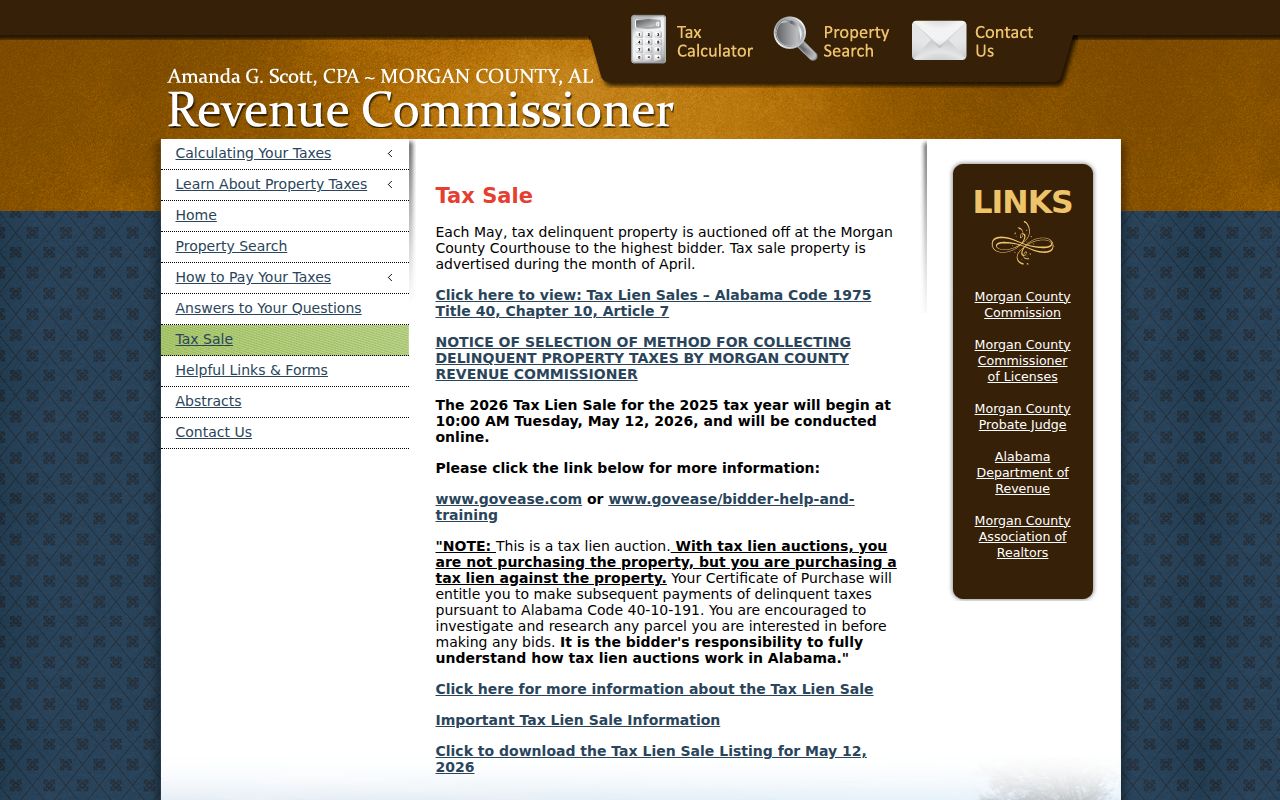
The page image backs up the lien-versus-land warning. Dates, lists, and statuses shift each cycle, so check the newest annual posting before relying on anything older.
Contest a Morgan County Property Assessment
Start with the Revenue answers page and the parcel's notice. Weigh the property facts, land and improvement values, class, exemption, and district against deeds, photos, surveys, repair records, and sound comparable sales. When an error appears, contact Revenue promptly.
No single appeal date fits every parcel. Revenue cites Alabama Code sections 40-7-74 and 40-2-11, yet the applicable window follows the notice and the current procedure. Preserve that date and route rather than waiting for the tax due date.
The appeal clock follows the assessment notice. Ask Morgan Revenue for the current protest deadline and required form as soon as the notice arrives.
Want assessed, market, and sale figures explained in plain terms? Continue to the Morgan County property value guide for the fuller picture.