
Trace Morgan County Former Owners Backward
Start with the newest vesting deed. Its grantor is your first former owner. From there, find the deed. That same person or entity took title through it. Work backward one transfer at a time. Confirm each match with the legal description, the deed pointer, subdivision and lot details, or section-township-range terms. The timeline shows which evidence to preserve along the way. It does not name owners for any particular parcel in Morgan County.
| Transfer stage | Grantor to grantee | Deed evidence | Identity check |
|---|---|---|---|
| Current vesting deed | Immediate predecessor to present grantee | Instrument, recording date, deed type | Full legal description and county parcel key |
| One transfer earlier | Earlier grantor to the latest deed's grantor | Book/page or instrument reference | Same tract, lot, acreage, and exceptions |
| Predecessor deed | Previous holder to the next known owner | Reverse index and prior-instrument citation | Name variants plus matching description |
| Older book era | Indexed parties in historical volumes | Index entry, deed-book page, and plat | Old road, subdivision, or section terms |
The Morgan Revenue property search gives you the starting parcel plus the LastDeed pointer, which points you toward the recorded transfer that follows. Treat it as a lead. The Probate instrument itself controls each next backward step in the property records chain.
Morgan Probate Starts the Recorded Chain
The Morgan County Probate Office is the recorder for deeds, real-estate mortgages, plats, easements, rights-of-way, liens, releases, and estate instruments affecting land. Its records anchor any owner-of-record search. The Online Records page provides a public land-record search. It also offers search hints, historical index books, and an account application. One caveat applies. Searching and viewing are separate access steps. The Morgan Probate Online Records page states that viewing and printing documents require a free account. The same page also lays out the separate route through the historical index books.
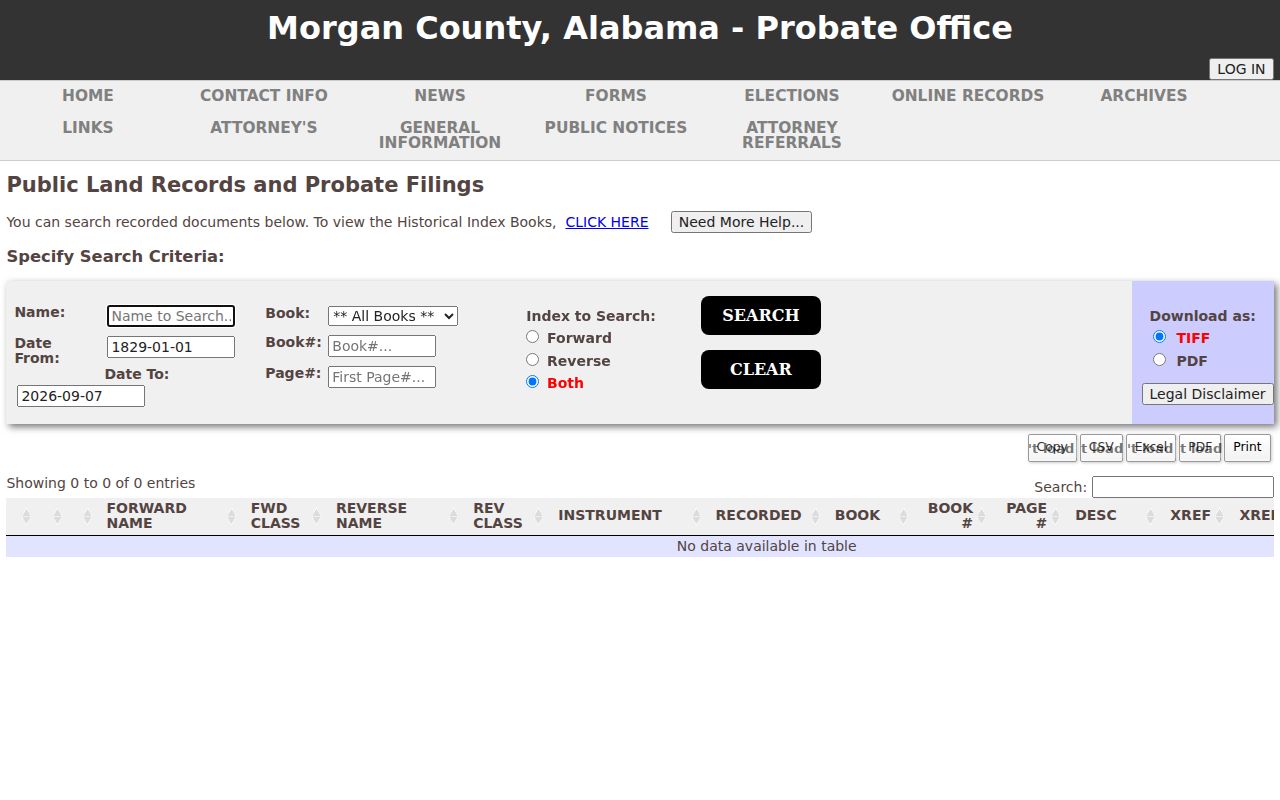
When an image sits behind the account wall, save what the index gave you: parties, instrument number, book and page, and the access limitation itself. That note keeps a gated image from turning into a false no-result in your deed records trail.
No Published Online Cutoff for Morgan Former Owners
Morgan County publishes no single earliest-online-deed year for its Probate records. So there is no clean cutoff to cite. Resist the pull of 1818 or 1821. Those years describe other county or archive series. They are not a verified deed-index starting point for Morgan County property records. The separate IndexBookBrowser confirms that historical index books belong to the fallback route. Still, each volume and date must be checked directly before you rely on it.
Online limit. The earliest searchable deed year remains unverified; continue through historical indexes, deed books, Probate staff, and Morgan Archives.
The distinction matters. An online name search in Morgan County deed records may stop well before the land trail does, so record exactly where the web search ended and which index book or office route carried the parcel trail forward.
Walk Morgan County Former Owners in Reverse
Start from a known present parcel in Morgan County and work backward. Finding the same surname is never the goal. The real proof is that each deed concerns the same land, deed after deed. You must also show that the grantor on one transfer matches the grantee on an earlier acquisition, which is what ties a Morgan County former owner to the parcel number itself.
- Find the current parcel in Revenue or GIS and copy its full PID, legal description, subdivision and lot, and LastDeed reference.
- Retrieve the current vesting deed and record deed date, recording date, grantor, grantee, deed type, consideration if shown, and prior-instrument references.
- Search the grantor as a prior grantee, allowing for initials, married names, entity changes, trustees, and estate representatives.
- Compare the legal description, acreage, exceptions, reservations, life estate, survivorship terms, and book/page before accepting the match.
- Repeat the process. When the online route ends, continue in the historical grantor-grantee indexes and deed books.
- Grantor
- The party conveying an interest in the instrument.
- Grantee
- The party receiving the stated interest.
- Chain of title
- The ordered sequence of instruments that links ownership through time.
- Reverse index
- An index organized to help search a party in the opposite grantor or grantee role.
- Warranty and quitclaim deeds
- Different conveyance forms whose effect must be read from the actual instrument, not inferred from the index label alone.
Match Past Owners to the Land, Not Just a Name
A matching name is weak evidence in a Morgan County index. A matching parcel identifier, legal description, and deed instrument is far stronger. A mailing-address match sits between those extremes. The address may belong to an agent, a lender, a tax representative, or an older owner of record. For platted property, compare subdivision, lot, block, plat book and page, and any replat. For rural land, carry the full metes-and-bounds description or the section-township-range reference. The county's live GIS map keeps situs and owner mailing fields separate, so neither should be quietly substituted for the other when you search Morgan County property records.
Estates and Joint Interests Can Break a Simple Owner List
Not every link in a Morgan County chain is a plain buyer and seller. An estate, trustee, personal representative, or surviving joint owner may sign instead. A life-estate holder, corporation, or quitclaim grantor can appear too. Each deed or land instrument should record the capacity in which that party signed. It should also show the interest the document actually conveyed. Probate papers may explain authority. Only the recorded deed shows what entered the real-property record.
Skip the temptation to force every transition into a tidy sale. Reservations, exceptions, survivorship language, and partial interests often leave several relevant names attached to one parcel. Check the prior-instrument reference and the legal description first. Only then decide whether one owner truly replaced another in the Morgan County property records.
Historic Plats Bridge Morgan County Former Owners
Older Morgan County instruments rarely carry street addresses in any consistent way. Renumbering, annexation, and mailing-city changes all break the address thread. A recorded subdivision name can keep the chain intact. So can a lot and block, road name, landmark, or section-township-range fragment. Plats add another layer, showing how a parent tract turned into later lots.
The Morgan GIS Subdivision and Lot Line layers help you find likely tracts. Retrieve the recorded plat afterward. A map layer proves neither title nor a surveyed boundary. In Decatur, Old Decatur and Albany history can explain old area names. Hartselle and Priceville parcels often shift with phase or replat names. The legal record must still supply the crosswalk.
Morgan County Former Owners in the Archives
The deed index can get hard to navigate. When it does, Morgan County Archives serves as the countywide fallback for inactive government records. Its holdings cover older maps, probate material, tax records, court proceedings, directories, and historical newspapers. A name, date, old address, estate notice, auction, or subdivision promotion can surface there. The property records alone may run dry. That is when the archives pay off.
Treat a newspaper or directory hit as a discovery source, never as vesting evidence. Morgan Archives' Decatur Daily run begins in 1919. Its Hartselle Enquirer run begins in 1926. Alabama archives list Decatur directory runs for selected early and mid-century years. Take the dated clue back to the deed record. The tax, estate, or plat record can also close the loop.
A Morgan County No-Hit Is Not the End of the Chain
A no-hit in an online index rarely means the deed is missing. Initials, variant spellings, and married names can all hide a match. Trustee and entity owners, account-gated images, prior street names, replats, and older index books can too. Write down the query, the filters, the date, and the result before switching methods. That record keeps the search honest. Then work the party variants and the land description separately. Either one can surface what the name search missed.
The Morgan County Probate office supports this layered work with online search, an account route, historical index books, and help in person or by staff contact. Morgan Archives holds older material still. Together these layers explain why a careful former-owner search reports a documented gap. They stop it from declaring that no deed or predecessor exists.
How Far Morgan County Former-Owner Records Reach
No single earliest deed year applies to online access across the board. A searcher should also resist the common fire story. The county has no verified courthouse fire or destroyed-deed event behind it. Morgan Archives lists probate records from 1818 to the present. That broad series description is not continuous deed coverage. The Archives' documented gap in marriage books runs from February 1818 through July 1821. That gap concerns marriages only, not deeds.
State the earliest deed or index entry actually inspected for the tract. Follow the chain carefully. The chain may reach an original patent or government entry. Verify that origin in the proper land source rather than treating the oldest county reference as the beginning. Some searches need only a single recorded copy. For that, the Morgan County deed records guide covers the document route. It does so without rebuilding the backward chain here.
Lawful use. Research past owners for property history, estate work, title diligence, and recorded-boundary questions. Never use it to track, target, or harass a living person.